Johnny Stick
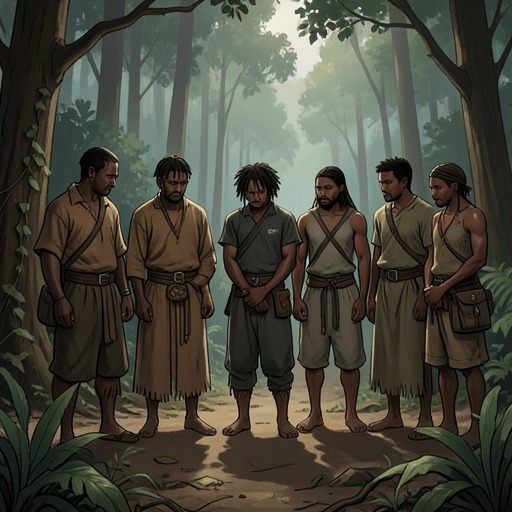
BarkskinsJohnny Stick, also called Mr. Stick, is a Mi’kmaw carpenter whose brief encounter with Jeanne and Felix turns a faltering search for Sapatisia Sel into a journey with a destination. Marked by childhood experience at residential school, he has begun attending truth and reconciliation meetings and recognizes the value of not facing such history alone. His help is generous but practical: the cousins earn their ride and lodging by helping him repair a lighthouse handrail, and when the first attempt to find Sapatisia fails, his sense of responsibility leads him to seek a more precise address.
Identity and background
Johnny Stick is introduced through Alice’s recommendation as someone safe to travel with. She says that he has been going to truth and reconciliation meetings for several years, connecting those meetings to painful events from his childhood at residential school. Her account presents him not as someone untouched by the past, but as a person who has found a setting in which he can recognize that others share the burden. Felix notices the feeling in Alice’s voice and asks what happened to him; the explanation is brief, but it gives his later quietness and care a history.
He is in his late middle years, clean-shaven, with a dark-jowled face. His red pickup carries an enormous cooler and, beneath a tarp, the sections of railing he is taking to the lighthouse. The details establish the workaday terms on which he meets the cousins: he is a tradesman on a job, with equipment and a route, rather than a guide appointed to solve their search. Yet his local knowledge and willingness to make room for them turn an ordinary work trip into an act of assistance.
Work and an agreement with the cousins
Stick offers Jeanne and Felix a clear bargain: if they help him install the railing, he will give them a round trip, a place to sleep, and dinner. Jeanne agrees. The arrangement makes their dependence reciprocal; the cousins are not simply passengers, but temporary helpers whose labor matters to the task. Stick’s offer is generous without being sentimental, grounded in what he needs done and what he can provide.
The repair itself shows how he approaches his work. In heavy, unmoving fog, he has the cousins hold the railing while he bolts its sections to braces. He attends carefully to the joins and angles, taking the pieces down again for minute adjustments until he is satisfied. He works without talking, and the job is not complete merely because the sections are in place: the accuracy of their fit matters. The next morning he says the railing needs cleaning, while Felix and Jeanne climb to the top of the lighthouse. His patience with the installation is a concrete form of care, though it does not make him a tireless or idealized benefactor; the work remains his priority.
The cousins’ lodging is equally makeshift. Stick lights a fire in the parking lot and cooks hot dogs in a dirty cast-iron pan, then retires to his truck. The cousins sleep in the lighthouse in their sleeping bags. The arrangement fulfills his promise of shelter and dinner, but its roughness keeps the scene rooted in temporary travel and practical accommodation.
Knowledge of Sapatisia and the failed encounter
When Jeanne and Felix explain that they are looking for Sapatisia Sel but do not know where she lives, Stick identifies her as Egga Sel’s daughter. He knows that she went to university and travelled widely, but he cannot give them a reliable address. He has seen a woman walking the cliffs with a basket, which he first mistook for a berry picker, though it was not berry season. During three nights spent in his truck while measuring the railing, he saw the woman a couple of times below the lighthouse, without approaching her. The sightings are suggestive, not conclusive: even Stick is unsure whether the woman he saw was Sapatisia.
His remarks also place the search in a dense network of Mi’kmaw kinship. Stick observes that it is difficult to find a Mi’kmaq person who is not related to a Sel, and mentions his own distant Sel cousins. His connection to the family is not presented as a direct route to Sapatisia, but it helps explain why he recognizes the name and why the search reaches him through overlapping local relationships. He knows enough to point the cousins toward the cliffs, but not enough to promise that they will find her.
Fog governs the attempt. Stick warns that there is little hope of seeing Sapatisia that day as he drives slowly toward the lighthouse. Jeanne spots movement near a storage building, and Stick points out a distant shape that vanishes almost as soon as he sees it. He suggests waiting until morning, believing the woman may return. The next day remains fogbound while the cousins help finish the railing. When Jeanne and Felix finally try to call to the woman, they hear an engine start; by the time they reach the bottom of the lighthouse, Stick’s red pickup is already roaring away along the road. He reads the departure as a sign that Sapatisia does not wish to talk, and offers Jeanne the choice of a ride back or staying. She accepts the ride. The fog has erased the hoped-for meeting, and the cousins leave without speaking to Sapatisia.
Responsibility and renewed assistance
Stick’s role does not end with the failed search. He feels obscurely responsible for the cousins’ disappointment and goes to Lobert Sel, whose mind is failing. Lobert nevertheless seems to remember where Sapatisia’s small house stands. He marks an inlet he calls Pussle Cove and gives the distance as a couple of kilometers east of the lighthouse, with no road sign to guide visitors. Stick passes the smudged paper to Alice, who places it beside Jeanne’s plate that evening. The information changes the search from speculation about a woman on the cliffs into a journey toward a named location.
The episode shows both the limits and the value of Stick’s help. He cannot make Sapatisia meet the cousins, and he does not claim certainty about the woman he saw. What he can do is offer a safe ride, let the cousins contribute to his work, share what he knows, and, after their setback, ask someone with a better memory of the place. That follow-through gives his concern a consequence: Alice uses savings from her East Coast Credit Union account to fund a rental car for Felix, since she has no license, and the cousins set out with an address rather than only a hunch.
Narrative role
Stick is a practical intermediary between the cousins and a landscape made difficult to read by fog, scattered homes, and uncertain sightings. The lighthouse provides a fixed landmark and a site for his carpentry, but it does not make the search straightforward: the woman disappears, and the road to her house has no sign. The careful labor of fitting the railing contrasts with the uncertainty of finding Sapatisia. One task can be measured, adjusted, and brought to completion; the other depends on local memory, weather, and another person’s willingness to be found.
His participation also makes assistance reciprocal rather than effortless. Jeanne and Felix help with the railing; Stick supplies transport and shelter; later he draws on an older relative’s knowledge and passes it along. His own history at residential school is disclosed in a few plain words, not expanded into a separate account, while the meetings Alice mentions establish that he has sought company in confronting it. The result is a modest but consequential portrait of a man whose care appears in work, hospitality, and a second attempt after the first has failed.