Aaron Sel
BarkskinsAaron Sel is Jinot Sel and Minnie Sel’s only surviving son, raised in a household where Mi’kmaw ancestry is part of his inheritance but not a life he initially knows how to live. His path from Nova Scotia to the sea and back again makes belonging a matter of practice and responsibility, not simply descent: he must learn what family and community require while confronting the damage done by disease, dispossession, and racial hostility.
Identity and Family Background
Aaron was one of twin boys born to Jinot Sel and Minnie Sel; his brother was Amboise Sel. Their resemblance to Kuntaw Sel, rather than to Hugh Boss, seemed to Jinot to mark his children’s Mi’kmaw inheritance. Aaron’s early family life nevertheless unfolded within the Boss household and among people whose expectations of safety were shadowed by illness and loss.
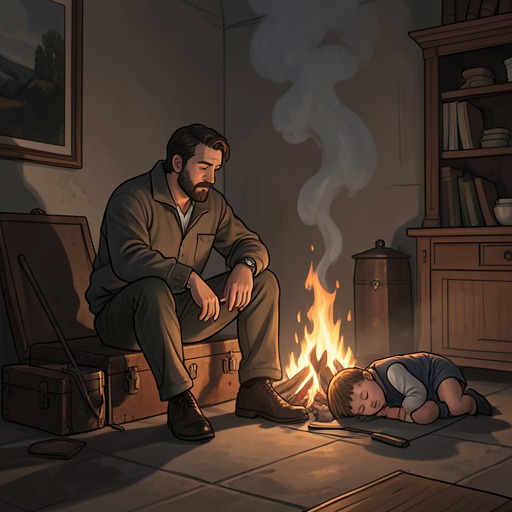
Minnie worried about her sons’ health and took them to Dr. Mallard when they began walking, concerned that scoliosis might appear. Her own posture continued to bend despite treatment, and her anxieties extended to Jinot’s frequent absences on business with Albert Bone. Those fears became part of the family’s reality when cholera killed Minnie and the twins Lewie and Lancey. Aaron survived after spending the morning in a woodshed with a book of tales and avoiding the well water associated with the outbreak. In the aftermath, Jinot told Hugh Boss that only he and Aaron remained.
The deaths brought Jinot and Hugh into conflict before grief reunited them. They set seven freshly cut stones in the cemetery, marked only with names, dates, and the word cholera. Jinot and Aaron then lived with Hugh, sleeping in the haymow and helping care for the surviving children until Mrs. Boss’s sister could arrive from Danbury, Connecticut. Jinot vowed to keep his son with him and protect him until adulthood, while Aaron increasingly spoke of going to Nova Scotia to find his Mi’kmaw relatives.
Leaving Home and Searching for Kin
When Jinot prepared to travel to New Zealand with Bone, Aaron refused to accompany him. He had entered a long, silent spell and eventually told his father that he did not want to cross the ocean; he wanted to find the Sel relatives in Nova Scotia and know their life. Jinot suggested that he could instead go west to Manitoulin Island and seek his uncle Josime Sel, who had returned to the old ways, but Aaron’s stated desire was to find his family in Mi’kma’ki.
After Jinot’s departure, Aaron made his way to Kuntaw’s family band. He arrived expecting a ceremonial welcome and the easy resolution of questions about who he was. Instead, he found that he did not know how to participate in the life he hoped to claim. He could not build an eel weir, identify blueberries, or hunt caribou and beaver; the animals he imagined hunting were no longer there. When he said that everyone was against him, Etienne Sel urged him to learn and brought him to the river to repair a weir. Aaron could not fit the rocks together or place the stakes correctly. He wanted a gun, but guns were unavailable to anyone without money. Kuntaw, the clan elder and sagmaw, answered that Aaron wanted too much and needed to learn to give, not take.
After two restless years, Aaron returned to Boston, still looking for Jinot, who remained in New Zealand. At the waterfront, two men drew him into an alehouse and bought him drinks. He later remembered walking with them toward the ships but not how he came to be aboard the Elsie Jones. He woke to find himself serving as a green hand on a vessel bound for London with spars and masts. Aaron protested that he had rights and could not be kept against his will, but his passage into maritime work began under circumstances he could not recall.
At Sea and the Return to Mi’kma’ki
At sea, Aaron acquired a sailor’s livelihood and skills, but the prospect of earning a living did not erase his pull toward family. On reaching Halifax, he collected his pay and shook hands with Binney, who told him the Excel would be back in April or May for another voyage to China. The familiar salt of the North Atlantic, mingled with the smells of softwood smoke and drying cod, brought him a rush of joy. He hurried through Halifax thinking about how to explain his return, aware that Etienne had been angry when he left.
His sense of himself had changed: he was ready to trap, make weirs, and fish, and no longer expected kin to honor him simply because he was Jinot’s son. He could imagine his seafaring knowledge becoming useful rather than treating it as a separate life. Yet the landscape on the way back showed the pressure of settlement. The trail he remembered had largely become cleared land, farms, and burned woodland. Two white children insulted him and threw clamshells as he walked. The sight of new shoots rising among tree stumps connected the changing terrain with the family’s displacement.
Aaron remembered that, five years earlier, a Mi’kmaw family had fed him and given him a place to sleep. They had said the Sels had gone to K’taqmkuk and that he could send word from Sydney, where someone would come for him. When he reached a ruined village instead, he asked what had happened to the people who had once helped him. He learned that sickness, hunger, and repeated displacement had devastated the community: people had been driven from places where they tried to build wikuoms, and even firewood was claimed by settlers. The account made the danger to his family in K’taqmkuk an immediate concern rather than a distant fear.
Aaron had once considered himself cold-hearted after Amboise’s death. Faced with the villagers’ suffering, he felt that response give way. He had no food to share, but he had his wages. He considered whether the people were too weak to buy provisions themselves and calculated that Halifax would take two days to reach and return from; Sydney was closer, and a farmer might sell him food along the way. He promised to come back with food and set out. The decision enacts the lesson Kuntaw had given him: belonging requires giving, not demanding recognition.
Reunion, Loss, and Reconciliation
Aaron eventually learned that Jinot had died in New Zealand from an illness in his injured leg and that Bone had also been killed. Hearing this news, Aaron looked toward the horizon and described his grief as an interior tearing. His father’s death did not surprise him, he said, because Jinot had been gone for so many years; he wished he had gone with him. He also acknowledged that he had once been a bad and foolish person, while allowing that he might have become different. Peter Sel answered that a person could improve.
The reunion with Etienne carries the same movement from absence toward a more candid kinship. Etienne told Aaron that the family had searched for him in Boston and never found him. Aaron remembered his earlier visit to Kuntaw and the Sels as a place-making project he had not understood: it had felt uncertain, like a cup that looked as though it held tea but contained only its shadow. That image gives form to the gap between arriving among relatives and actually understanding the life they are trying to sustain. His return does not erase the years of separation, but he now approaches family without expecting that ancestry alone will settle his place.
Narrative Significance
Aaron’s story is set against accounts of Mi’kmaw land loss and the continuing effort to preserve community under colonial pressure. Earlier, Père Crème had insisted that the Mi’kmaq loved their country and children, even as French authorities took their land and disrupted their lives. Later, Sosep warned that settlers, their livestock, boats, nets, and introduced plants were consuming the conditions of Mi’kmaw survival. He urged his people to keep their own world alive in thought and practice, even as they were forced to live in two worlds. Aaron’s difficulties returning to that world are personal, but they also register the consequences of generations of upheaval.
The novel places his eventual search for kin beside the different understandings of land and knowledge expressed throughout the story. Theotiste Sel rejects the claim that a French king can give away land that is not his to give. Kuntaw teaches that the forest and shore are connected through knowledge of animal tracks, plants, weather, and water, and that learning these relationships is part of Mi’kmaw life. Aaron’s first failure to understand that inheritance, and his later readiness to help people he has just encountered, make his development practical rather than ceremonial. He does not return as someone already equipped with the old knowledge; he returns as a person willing to learn and to accept obligations to others.
His arc is also shaped by separation across generations. Jinot’s departure for New Zealand leaves Aaron to pursue a different route toward belonging, while the colonial destruction of Mi’kmaw communities repeatedly makes kin hard to find. Aaron’s search does not produce a simple restoration of an untouched past: the country he remembers has been cleared, a village has been ruined, and his family has moved. What changes is his understanding of what it means to come back. Family is not a welcome owed to him, but a relationship made through learning, work, grief, and care.