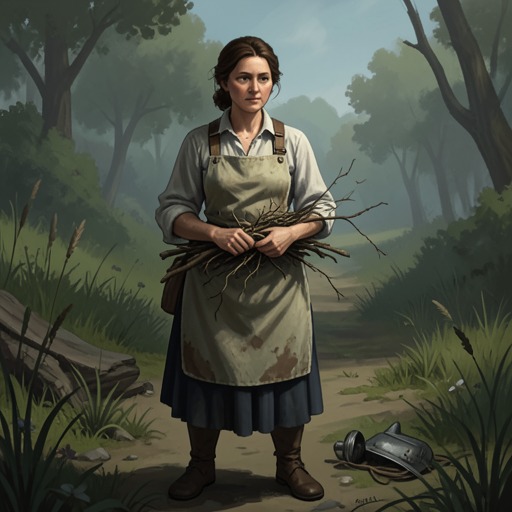
Auguste
BarkskinsAuguste is Noë’s son, Achille’s nephew, and Kuntaw’s cousin. Born from violence in the colonial borderlands, he grows up within a Mi’kmaw family whose children must find their place amid the transformations of their elders’ world. As he learns to hunt and travels north with Achille and Kuntaw, Auguste becomes part of a living chain of family knowledge; when Achille later departs to find a safer place, he is among those left in Elphège’s care.
Identity and Background
Auguste’s birth follows Noë’s rape by two boys from the French settlement, one of whom was Dieudonné. Dieudonné later died with his father, uncle, and other Acadians when their fishing boats were caught in a storm. Noë told Elphège what had happened after her brothers returned from the St. John; Auguste was the consequence of Dieudonné’s life. The account establishes Auguste’s origins plainly, without making his identity reducible to them.
His childhood unfolds far from the home of René and Mari, among the family’s Mi’kmaw relatives in Mi’kma’ki. The children are trying to find their place in a world unlike the rich Mi’kmaw past preserved in Mari’s stories. Auguste’s life therefore begins within overlapping histories: the family’s displacement, the pressures of French settlement, and the effort to sustain kinship and ways of living on Mi’kmaw land.
Family and Separation
As a young child, Auguste is with Noë when she sees his brothers, cousin, and Zoë heading away along the shore. Their boots tell her that they are going to work for the French logger rather than setting out to hunt moose. Noë gives Auguste a small stone and urges him to throw it at the departing family, acting out an anger she recognizes as an imitation of Renardette’s drunken fits. He throws the stone, which falls onto the path; Zoë turns back and waves to him, and Achille also salutes. Noë and Auguste return to the house, where she says they will eat dinner together.
The scene makes Auguste a witness to separation before he can understand its causes. Noë’s anger is mixed with knowledge that her outburst is an imitation and that the family’s departure may not be permanent. The small stone, the unanswered call, and the farewells show how economic pressure reaches into family life: the men are leaving for a logger’s work instead of the hunting expected of them.
Learning to Hunt
Years later, Achille plans a two- or three-moon hunting journey north with his oldest son, Kuntaw, and his nephew Auguste. Auguste is older than Kuntaw and already knows how to kill birds and frogs. When Achille first gives Kuntaw a tiny bow and blunt-ended arrows, the younger boy imitates Auguste; after Kuntaw kills a grasshopper, the family displays it on birch bark and welcomes him as a new hunter with a feast and a grasshopper dance. Auguste is thus both a model for his cousin and a participant in the family’s teaching of hunting.
The journey takes the three through waterways, forest, and increasingly open country. On the third day, Auguste shoots a swimming beaver, dives in to retrieve both the animal and his arrow, and brings the beaver ashore. Before he returns, Kuntaw shoots another, and the two cousins bring both animals back to camp. Their successful hunt supplies food and confirms Auguste’s practical competence within Achille’s northern journey.
Auguste also travels with Kuntaw toward the taiga and tundra, where Achille describes the transition from birch and spruce to a country of little sticks. Along the way the party encounters Cree travelers, sharing food with them as they build canoes. Auguste names a lake Moosehead Lake and calls a broad stretch of tundra Walking-in-White-Things Place. These details show him participating in the journey not merely as a learner but as an observer and namer of the country they cross.
Achille’s Departure and Auguste’s Future
After violence and mourning disrupt the family, Kuntaw declares that he will go with Achille, and Auguste calls from outside the wikuom that he will go too. Achille does not take the boys with him immediately. He tells them to stay with Elphège until he sends word, explaining that he must first find a safe place and be alone with what has happened. Elphège will help care for Kuntaw and Auguste, but Achille’s grief, the narration emphasizes, is beyond anyone’s ability to relieve.
Auguste’s story in these episodes is marked by repeated departures: relatives walk away to work for a logger, and later Achille leaves in search of safety. Against those separations, the family’s practices continue through shared meals, hunting, travel, teaching, and care. Auguste’s development from Noë’s small child into a hunter on a northern journey gives that continuity a concrete form, while his place in the family remains exposed to the colonial and personal ruptures surrounding it.
Narrative Significance
Auguste connects two kinds of inheritance. His birth records the violence of contact between the Mi’kmaw family and French settlers; his upbringing and hunting journey show knowledge and kinship continuing within that same unsettled world. The narrative does not present the northward journey as escape from history: it is an enacted family practice, shaped by Achille’s responsibilities and by the possibility that more English settlers will come.
His presence also links generations. Achille teaches and guides him, while Auguste’s existing skills help Kuntaw take his first steps as a hunter. When Achille must leave, both boys are entrusted to Elphège. Auguste’s significance lies in this position between rupture and continuity: he bears the consequences of violence and displacement, yet participates in the family’s transmission of skills, names, and relationships to the land.