Al McErlane
BarkskinsAl McErlane is the experienced greenhouse manager whose steady work gives Conrad a practical starting point for transforming Dieter’s small nursery into a forestry and restoration enterprise. He is not presented as a prominent executive or an expert in the emerging science of propagation; his importance lies in his long continuity with the greenhouses, his clear-eyed account of their limitations, and his willingness to engage Conrad’s renewed ambitions.
Identity and Background
McErlane had managed Dieter’s greenhouses for years, remaining their single employee while the seedling business operated on a small scale. When the company faced hard times after the 1929 crash, Conrad remembered Dieter’s nursery and considered whether it might have a future. He chose not to close or sell it before assessing its work, and went to speak with McErlane, the person who had kept the operation running.
The nursery was a modest inheritance from Dieter’s forestry interests rather than a thriving industrial concern. Its customers were mainly local parks and private landscaping businesses, and its principal products were spruce and pine seedlings. McErlane’s long service connected the nursery’s earlier, relatively limited activity to Conrad’s later effort to make seedling production central to the company’s relationship with forests.
The Nursery and McErlane’s Assessment
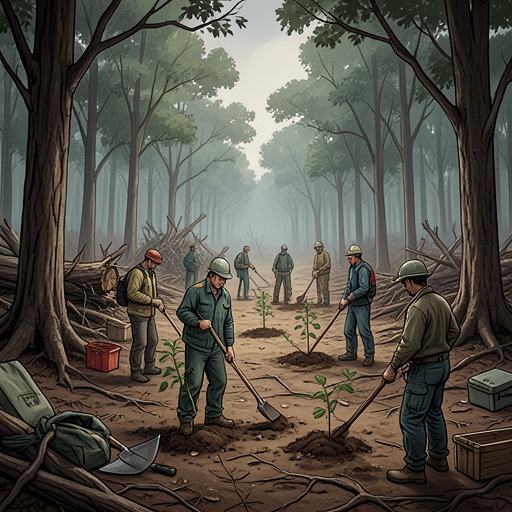
The greenhouses had changed little since Conrad’s childhood visits. Hoses still crossed the wet concrete floors, but Conrad now noticed the seedlings that he had overlooked as a boy. He examined account books and client lists before asking McErlane about the business’s position and prospects. McErlane was surprised by the seriousness of the inquiry; he had expected Conrad to announce that the nursery would be sold or shut down.
McErlane described an industry with little incentive to invest in planting. Timbermen who wanted regeneration usually left a few seed trees and trusted the forest to do the rest. In his account, the approach persisted partly because logging companies had little money during the depression and partly because they did not believe in buying and planting seedlings. He also reported that a representative from Weyerhaeuser had recently asked about the nursery’s setup and seed sources. The possibility that a better-financed competitor might establish its own nursery made the business’s weaknesses, as well as its potential, more immediate.
Conrad observed that Dieter had been working with seedlings decades earlier, and wondered whether that pioneering interest could now become commercially important. McErlane agreed that the nursery had a future. His reply did not erase the gap between that prospect and the business as it stood: the five glasshouses were old and in poor condition, the customer base was narrow, and the customary practice of leaving seed trees was not reliably restoring logged land.
From Greenhouse Routine to Forestry Research
The conversations and walk through the five glasshouses revealed that neither Conrad nor McErlane knew enough about the developing technical demands of large-scale reforestation. Conrad found that McErlane, like himself, lacked familiarity with newer research into seedling propagation, cloning, forest genetics, and site preparation. The discovery prompted Conrad to admit that he first had to learn the field before devising a new plan. He intended to keep the existing greenhouses operating for their remaining clients while he attended forestry school.
McErlane’s practical experience remained part of the work, but the nursery’s future would require knowledge and methods beyond its established routine. Conrad investigated why generic bare-root spruce and pine seedlings often failed on rough, logged-over ground; he considered the expense of preparing planting sites, which species might suit different conditions, and how fire and competing grasses could affect regeneration. His study led him toward the conclusion that companies could not depend on scattered wild trees to reseed barren cuts. They would need to plant seedlings, prepare sites, and think across decades rather than only immediate logging returns.
Conrad’s decision to make site preparation a company service emerged from this larger reassessment. The nursery was not simply to sell young trees: its success depended on persuading lumber companies that their future timber supplies were linked to regeneration and on addressing the conditions that determined whether planted seedlings survived. McErlane’s candid account of the existing operation helped expose the distance between its small, local business and that broader ambition.
Growth and Continuing Partnership
By 1939 Conrad had developed a long-range plan. He built new greenhouses and established an experiment involving eleven tree species. McErlane continued managing the nursery, now alongside two new workers, Pedro Vaca and Hank Stone. The operation also gained a separate laboratory-office, although Conrad had not yet found the research horticulturist or plant breeder he wanted. McErlane’s continued presence thus carried the business from Dieter’s small greenhouse enterprise into a more deliberate program of experimentation and forestry work.
Conrad was called up during the war and returned from the South Pacific in 1945 changed by his experience. His first renewed contact with McErlane was a handshake; together they walked through the seedling greenhouses. The rows of sturdy young pines struck Conrad with a force they had not possessed when the nursery was merely a family business he might have chosen to close. McErlane’s ongoing stewardship made that return possible, while the seedlings represented the enterprise Conrad had chosen to preserve, study, and enlarge.
Narrative Role and Significance
McErlane’s role is defined by continuity and practical candor. He maintains the nursery across years when seedling production is marginal, explains why timbermen do not replant, and confirms that the old business might support a new direction. He does not provide the advanced research Conrad recognizes as necessary; instead, his limitations help make the need for education, experimentation, and new expertise visible.
Through McErlane and the nursery, the novel gives environmental responsibility a concrete workplace: account books, aging glasshouses, seed sources, client lists, and seedlings that must survive after planting. Against the expansive confidence of extractive logging, this small operation points toward a longer measure of value. Its work depends on preparing land and planting trees whose growth will extend beyond the immediate concerns of the people who set them in the ground.