Charles Duquet
BarkskinsCharles Duquet is a French-born opportunist whose life gives the novel’s timber empire its founding ambition and its defining contradiction: he recognizes the forest as a source of immense, seemingly permanent wealth, while the trade built on that belief repeatedly leaves depleted landscapes behind. A poor engagé who survives hardship through calculation, he becomes a merchant and landowner, but neither his commercial legacy nor the family name he hopes to establish follows the line he imagines.
Identity and Early Circumstances
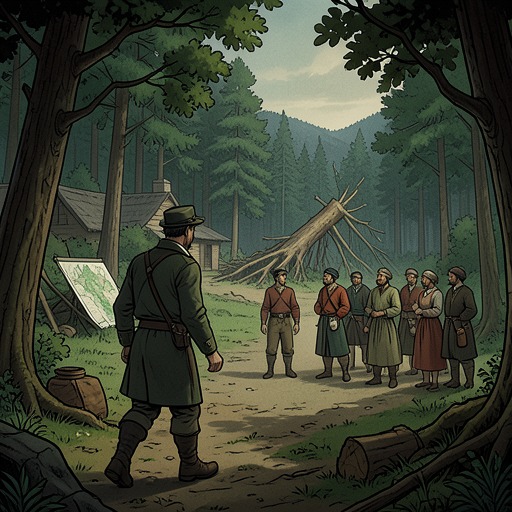
When René Sel first sees Duquet in New France, he is a scrawny ship’s servant, remembered from the voyage as a man who folded into a corner. Monsieur Bouchard calls him forward as a familiar of Monsieur Trépagny; René assumes that Trépagny has acquired two servants. Duquet’s tattered droguet cloak gives little indication of wealth or status. His early position is marginal: he arrives not as a proprietor but as a poor newcomer within a society organized around unequal claims to land and labor.
Duquet understands the seigneurial arrangement from the inside. He explains to René that the seigneur apportions land to censitaires, or habitants, who pay for its use through three years of labor and products such as radishes and turnips. The system offers him a route into colonial property relations, but he does not regard its limits as a reason to remain subordinate. His attention is already trained on the difference between land granted for use and resources that might be converted into lasting private wealth.
Escape, Survival, and the Forest’s Promise
After escaping Trépagny, Duquet travels west along a river, wary that Trépagny and René Sel may pursue him. He carries a sapling cut for a walking stick and food hidden in his jacket, drinks river water, and keeps moving through rough, gullied terrain. Hunger forces him back to the bank, where he knots the neck and sleeves of his shirt into a makeshift fish trap. The episode presents survival as practical improvisation: he treats the wilderness not as a home but as terrain to be navigated until another opportunity appears.
Later, Duquet turns that habit of calculation toward his future. He wants children and a family name, imagining that the name Duquet might change from a curse into an honor. His damaged appearance makes marriage seem difficult, and he concludes that money may be necessary. The wish for descendants therefore develops alongside the wish for capital: family standing is something he believes wealth can secure.
His central commercial insight is to reject animals and other resources whose numbers or markets might fluctuate. Beaver, fish, seals, game, and birds can disappear; timber, he believes, cannot. Recalling that English colonists sell pine for naval masts, he imagines that French traders could build a comparable enterprise. He regards the forest as vast and self-renewing, capable of supplying ships, houses, and fuel, and sees transport and markets as obstacles to be solved rather than reasons for restraint. The belief that forests are effectively inexhaustible becomes the premise on which he plans a fortune.
Trade, Property, and Family Strategy
Duquet’s commercial life reaches beyond New France. In India, Captain Verdwijnen trades ceramics and silks for cabbages, fruit, spices, and a chest of Patna opium intended for medicinal trade in Amsterdam. Amid this exchange, Duquet’s attention returns to forests. The moment places his timber ambitions within a wider network of commodities moving between colonial and European markets: he is attentive not only to the goods at hand but also to the possibility of making wood the basis of a much larger business.
In Amsterdam, Duquet attends a formal dinner at Captain Verdwijnen’s house dressed in finery, an ivory set of teeth, and a heavy wig. The gathering includes the captain’s family, Piet Roos and his household, and the table Verdwijnen had bought for his wife in Guangzhou. The scene contrasts Duquet’s carefully constructed appearance with the vulnerable newcomer René had first seen. It also shows the social world he seeks to enter: trade connections, marriage, and visible prosperity are intertwined.
His courtship of Cornelia Roos is correspondingly strategic. While working with the Trépagny brothers, he grows impatient with their narrow vocabularies and repetitive stories, yet drives them through a hurried fur-gathering season, particularly seeking wildcats. He sets aside two fine pelts as gifts for Cornelia and tells her father, Piet, that he intends to marry her. Duquet notices her health and appearance, but the attraction that matters most to his plans is her father’s commercial network and his allegiance with Captain Verdwijnen. He expects Cornelia to bear sons who can help build the business. Marriage, in his calculation, is at once a personal wish, a route to trade connections, and a means of producing heirs.
Duquet’s dealings with other people are governed by a related understanding of power. Advice about him describes a lowborn, self-made businessman who is greedy, impulsive, and susceptible to manipulation, but who respects older men and can be influenced by patient listening rather than open opposition. This portrait complements his own methods: he reads people for their vulnerabilities and usefulness, just as he studies land and commodities for their potential value.
Building a Timber Enterprise
Back in New France, Duquet examines, measures, and calculates across the commercial landscape. He converts limbs and low-quality hardwood waste into saleable firewood and sends twenty wagons each autumn to the Kébec market. When ships are available, he also sends cargoes toward Paris, seeking return goods such as tea, coffee, textiles, spices, or china. He is willing to let Parisian customers go without if there is no profitable return cargo. The policy reveals a merchant who treats transportation as a two-way calculation, not a service to buyers.
Leasing Piet Roos’s ships is useful but insufficient for his ambitions. Duquet wants vessels of his own and hopes to find a capable shipyard in New France; discussions among Kébec entrepreneurs with the French government come to nothing. His enterprise thus depends on the same infrastructure that limits it: ships, markets, and political arrangements must connect forest resources to distant buyers. The gap between his expansive plans and the available means does not displace his belief in the opportunity.
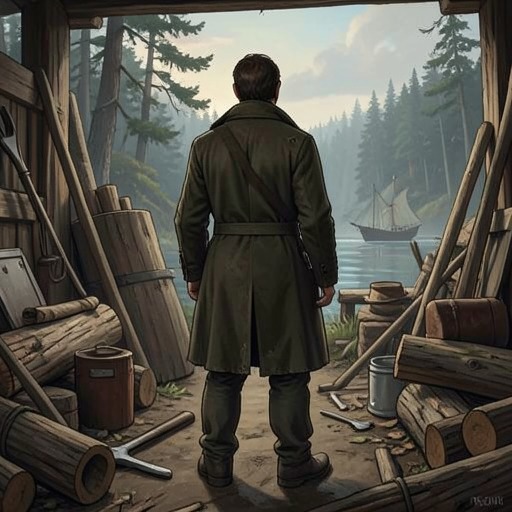
A later visit to one of his new white-pine properties with Forgeron gives that belief a concrete scale. The tract covers twenty thousand acres and costs twelve cents an acre. On an October afternoon, the men land their canoe on a sandy Maine river shore, where a narrow line of ice borders the shaded water. They begin gathering firewood without speaking. The property is at once a measurable asset and a living landscape; its acreage and low purchase price make the forest legible as capital even as the scene retains the physical setting in which extraction will take place.
Violence, Succession, and the Uncertain Legacy
Duquet’s insistence that he has made himself without help turns into a destructive conviction. When his anger erupts, he cries that no one helped him, that he did everything himself, endured hardship, contended with powerful men, and accepted the risk of dying in the wilderness. He then kills a boy with a tomahawk. The episode makes the cost of his self-made identity explicit: endurance becomes, in his own account, a claim that no obligation to others can restrain him. His ambition is not merely acquisitive; it is bound to a story of solitary struggle that licenses violence when that story is challenged.
His later fate is described through the danger of the timber world he helped create. Dud McBogle, recognized as a timber thief who had once turned back after calling to a wounded boy, reappears amid moving saws. The recognition brings Duke into immediate peril. At fifty-three, with his fortune only half-secured, he is finished. The abrupt ending cuts against the promise of a fortune that could expand indefinitely: wealth remains incomplete, and the enterprise’s machinery carries mortal danger within it.
Yet the business survives him. Bernard Duke later recalls learning the work of a landlooker from Charles Duquet before Duquet’s unexplained disappearance and then from Forgeron. Bernard worries that no nephew can assess timber as Duquet did—judging trees and estimating cubic volumes and board feet—showing that the founder’s expertise had become a crucial part of the company’s inheritance. Bernard also remembers him as a very good businessman, whose disappearance was a loss to Duke & Sons. The family retains his commercial competence even where it cannot preserve a reliable account of his end.
The family record is still more unsettling. A portrait arranged to show Piet Roos and Cornelia leaves Charles Duquet absent; only Outger and Doortje stand for him, and the people he had imagined as a family have forgotten him. Much later, Lavinia Duke calls herself the last surviving Duke and commissions searches into the family’s origins. The investigation establishes that Duquet adopted three sons—Nicolaus and Jan from an Amsterdam orphanage and Bernard from the streets of La Rochelle—and divided his goods equally among them. Lavinia descends from Nicolaus, so the Duke line carries no Duquet blood through that branch.
The same account distinguishes his biological descendants from the line that inherited his name and property. After the adoptions, Cornelia bore Duquet two biological children, Outger and Doortje. Doortje’s line ended with her only son, Lennart Vogel, who died unmarried. Outger lived for a time on Penobscot Bay, had a daughter, Beatrix Duquet, with an Indigenous woman, and later moved to Leiden while Beatrix remained in Maine. Beatrix eventually married Kuntaw Sel, a métis descended from Mi’kmaq people and a French habitant. The disclosure overturns the family’s presumed descent and reconnects Duquet’s biological line to the people and place of his colonial life.
Narrative and Historical Significance
Duquet’s personal rise gives the novel a human scale for tracing the timber economy from forest property to trade networks and, in later generations, industrial extraction. His early decision to treat forests as renewable without limit is echoed by later logging operations that cut successive tree species, burn vast accumulations of felled wood, and leave camps amid stumps and waste. In that later account, newcomers take whatever yields profit and regard the forest as existing for their use. The contrast between Duquet’s confident theory of endless replacement and the material consequences of intensive cutting turns his business idea into an inherited environmental assumption.
The legacy also runs through places beyond the original New France setting. Duke & Breitsprecher sends its first shipload of best pine to Sydney, Australia, where a buyer seeks a decade-long supply contract and expresses interest in kauri as well as Michigan pine. In an earlier dinner conversation, Lavinia imagines looking beyond Europe to unfamiliar countries for valuable kinds of wood; the narration places Duquet’s bones beneath eastern leaf mold and forest soil as she speaks. The juxtaposition makes his outlook feel less like a completed episode than a principle carried forward by successors: distant forests become the next frontier of commercial possibility.
That continuity is not the same as biological continuity. Duquet’s business knowledge passes into Duke & Sons, and his adopted descendants carry the family name, yet the genealogical search reveals that the presumed bloodline is mistaken. His legacy is therefore divided among an enterprise, a theory of the forest, and several competing lines of descent. The distinction is central to his character: he sought to turn a name into an honor and a family into an instrument of permanence, but the company remembers him more securely than the bloodline he hoped to establish.