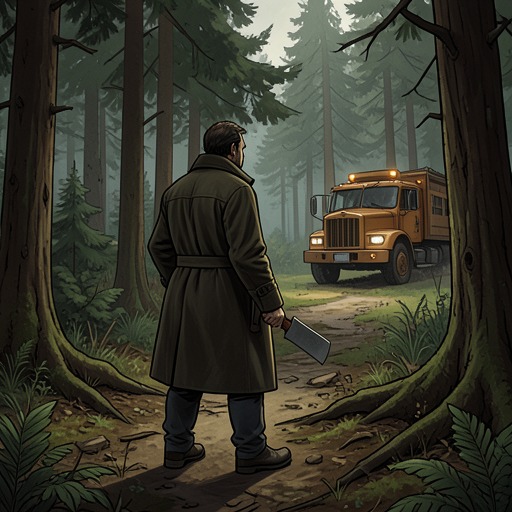
James Duke
BarkskinsJames Duke’s life turns on reversals of fortune: a boy his father considers sending toward the sea, a naval officer stalled for years in his career, and then a middle-aged captain summoned to Boston by the promise of an inheritance. He receives wealth, land, and a place in Duke & Sons, but the forests behind that fortune are not endless. As he tries to keep the company supplied with timber, his decisions help extend its reach into Michigan even as the destruction he sees there challenges the assumption that another forest will always be waiting. His death in a winter wreck leaves his daughter Lavinia to inherit the business and its unresolved responsibilities.
Identity and Early Career
James is the son of Sedley Duke and a member of the Boston-based Duke family. When the possibility of a sea career arises, someone points out that Sedley has discussed the character and confidence a boy might gain by going to sea without considering his own son. James is old enough to enter as a midshipman. Sedley says he will consider it, but worries that Royal Navy service would place James on the enemy’s side as colonial feeling against England strengthens. He thinks instead of finding a berth for him on an American privateer. The exchange places James’s prospective career within the family’s political and commercial world: the sea offers advancement, but also raises questions of allegiance.
James does enter naval service. He does moderately well in his examination but remains for years a “passed midshipman.” The Napoleonic Wars eventually propel him past a lieutenancy to the rank of post captain, where his advancement stops. In his early fifties he is described as complicated, dark-haired, and somewhat handsome, adopting a hard-headed and hard-handed manner to conceal a sense of worthlessness. He swings between self-pity and rigid authority over himself and his crews, and expects the future to bring disappointment. His long delay in advancement gives the invitation from Boston an unusually consequential force.
Inheritance and Return to Boston
A letter from his Boston cousin Freegrace Duke asks James to consider a vacant director’s seat on the Board of Duke & Sons after Sedley’s death. Before James can write a refusal, attorney Hugh Trumbull sends him a draft for one hundred pounds toward his passage to Boston and asks him to attend a meeting at Trumbull & Tendrill to hear something to his advantage. Because that prospect of advantage is so rare in James’s life, he accepts the offer and decides to move permanently to Boston. The letter changes the direction of his life: instead of remaining in England, he returns to the family enterprise he had not expected to inherit.
At Trumbull’s office, James’s resemblance to his late father is immediately remarked upon. Trumbull then explains Sedley’s will. James returns to the Pine Tree with a weight of keys in his pocket and learns that Sedley has left him half of his rich estate, apparently regretting his long hatred. The inheritance is concrete and sprawling: a dwelling north of Tremont Street with six acres of garden land, an orchard, twenty acres of meadow, a twelve-stall stable, carriages and matched horses, six warehouses of lumber, interests in ships, and nearly two million acres of Maine forest. The bequest also includes money, household goods, books, and objects such as a stuffed crocodile and a turtle-shell-hafted knife. The property makes James not merely a returned son but a major timber owner and company director.
At a gathering with his cousins, James is scrutinized for how closely he resembles Sedley. Unable to find another subject after an account of a damaged husband, he begins describing his surprise and delight at the inheritance. The resemblance is more than a passing observation: Freegrace says it is as if Sedley had gone away for six months and returned younger. James’s new position therefore brings him into the family not only as an heir to Sedley’s property but as a visible reminder of the father whose absence and estrangement shaped his earlier life.
Marriage, Family, and Authority
In Boston, James courts Posey Breeley Brandon through a summer and into the changing seasons. He is fifty-five, twenty years older than Posey, and knows that his cousins may disapprove of the age difference. He regards her as the crown of his joy and believes that no one else can understand what she means to him. Their courtship unfolds in the rose garden, circling a sundial as they talk of lumber and love; the blossoms move from first leaves to full bloom and then to frost-browned decline. The seasonal progression gives their courtship a sustained place in James’s new life, following years in which he had felt poor, passed over, and crushed.
James’s authority within the marriage initially takes a financial form. He keeps Posey on a liberal but strict allowance: if she exceeds it by a penny, the next month’s amount is halved. The arrangement is described as his only ascendancy over her in their early days, and she finds him rigorous. After their daughter Lavinia is born, and after James and Posey resume subdued marital relations, Posey changes. Her affectionate care extends to Lavinia, James, their cousins and their wives, and the household staff, though not to her father Phineas Breeley, whom James has sent far away to New Brunswick. Posey reads stories and poems from Tales of the Robin to Lavinia every night, and the child develops a tender regard for the bird in the book. The family household thus acquires a recurring domestic ritual alongside James’s business responsibilities.
James takes an active interest in Lavinia as she grows up. At breakfast he watches her enter in a mustard-colored wool dress, seeing that she has changed from a sullen child into a young woman. When she tells him she does not want to be presented socially, attract a suitor, or marry, but wants to learn the timber trade, she makes a claim on the business that challenges the usual expectation for her future. The surviving evidence establishes her ambition and James’s presence for its declaration; it does not establish the terms on which he answers it at that moment.
The Search for Timber and the Michigan Decision
The business James inherits depends on a premise he had encountered even before his return to Boston: that forest could be a lasting source of wealth. Charles Duquet had rejected beaver, fish, seals, game, and birds as commodities vulnerable to disappearance and unstable markets, and concluded that Europe lacked an apparently inexhaustible resource: forest. He had considered the English colonists’ pine-mast trade and imagined timber serving ships, houses, and warmth indefinitely. Elsewhere, during a trading voyage in India, Duquet’s attention returned to forests even as cargo was exchanged for produce, spices, and opium. These earlier episodes frame the commercial inheritance James receives: the forest appears both as material supply and as the promise of fortune that can renew itself.
That promise begins to fail in practice. Lennart Vogel warns James that Duke & Sons has had several lean years and few good timber tracts left in New England or New York State. The pine has been cut out. Ohio, which Sedley had bought, no longer contains the stands of white pine the company expected: settlers have arrived in large numbers and burned and cut the forest. James acknowledges that the company’s familiar method—buying land or stumpage, cutting it, and making no plan for where replacement timber will come from—could undo it. Trees grow too slowly for the nearby forests to be treated as permanent. He remembers that Cyrus Hempstead had once identified opportunities in Pennsylvania, but Edward Duke delayed, and competitors took them.
James responds to Vogel’s warning by agreeing to go with him and a Breitsprecher to investigate new timber country. Vogel and James later present the Board with the case for Michigan: its great pines, connected rivers and streams, access to Lakes Huron, Michigan, and Superior, Detroit’s position between Huron and Erie, and transport links through road expansions and the Erie Canal to Albany and New York City. Edward and Freegrace remain unmoved, while Cyrus nods in agreement. James then offers to use his own money to secure the lands and resell them to the company at an additional twenty-five cents an acre. The offer converts his personal fortune into a tool for expansion and bypasses the Board’s hesitation.
The find deepens James’s influence but sharpens the ethical cost of the company’s growth. Armenius Breitsprecher recognizes that Duke & Sons’ appetite is so great that it seems intent on clearing the continent, and that he is helping it do so. He abhors the waste of sound wood, the destruction of soil, gullying and erosion, and the lack of thought for the future. He sees the belief that supply is endless—because another forest can always be found—as a force that may become the company’s central engine. The contrast between James’s recognition that nearby timber is not eternal and the continuing search for new tracts is central to his business story: knowledge of depletion does not itself halt expansion.
Leadership, Death, and Legacy
After Lennart’s loss, James carries a much heavier share of the company’s operations. He manages jobbers, newly hired landlookers and scalers, reports on lumber volume and camp yields, sawmills, equipment requests, milling technology, and commissions to shipyards building lumber barges for delivery to Albany. Cyrus cannot simply take over Lennart’s work: he already handles the complicated order department and knows the naval buyers and lumber dealers. Nor can anyone replace Lennart’s accumulated company history and timber knowledge. James’s burden shows how the company’s vast reach depends on particular people and practical expertise, not just acreage or capital.
His own household and business obligations continue to overlap. Before leaving Boston for about six weeks, he tells Lavinia he intends to have his wine crated and shipped and to arrange bottle racks in his cellar. He will stay at Black Swan, and has asked Cyrus to help her procure anything she needs while he is away. The scene sets the ordinary details of family life beside the scale of the timber enterprise: James’s plans still include a cellar, a hotel, and his daughter’s access to company support even as he bears responsibility for a far-flung operation.
James’s death comes during a winter voyage on the Great Lakes. Drawing on his experience at sea, he senses the steamer struggling and knows that Lake Erie storms wreck ships. Duke & Sons has already lost two lumber boats the previous winter. When the vessel pitches violently and its timbers groan, James puts on his heavy coat, hat, and gloves and goes out on deck. The ship is wrecked. Lavinia insists that the family go to the site, and she and Cyrus take two days to reach the shore in extreme cold. Among the stumps they find more than thirty frozen bodies, including James. His death abruptly ends the career of the returned captain who had become a principal figure in Duke & Sons and leaves his daughter to carry forward the company.
The family inheritance is also unsettled by the discovery of its actual lineage. When Lavinia asks about her family tree, she learns that Charles Duquet adopted Nicolaus and Jan from an Amsterdam orphanage and Bernard from the streets of La Rochelle. The adoptions were informal, but Charles treated the boys as sons and divided his goods among them. Lavinia descends from Nicolaus, who married Mercy and had Patience, Piet, and Sedley; consequently, she has no Duquet blood, but descends from an adopted son. James’s inheritance therefore passes through a family line whose commercial power rests on adoption and recognized kinship rather than biological descent. His life embodies the novel’s recurring tension between family identity, property, and the forests that sustain inherited wealth.